
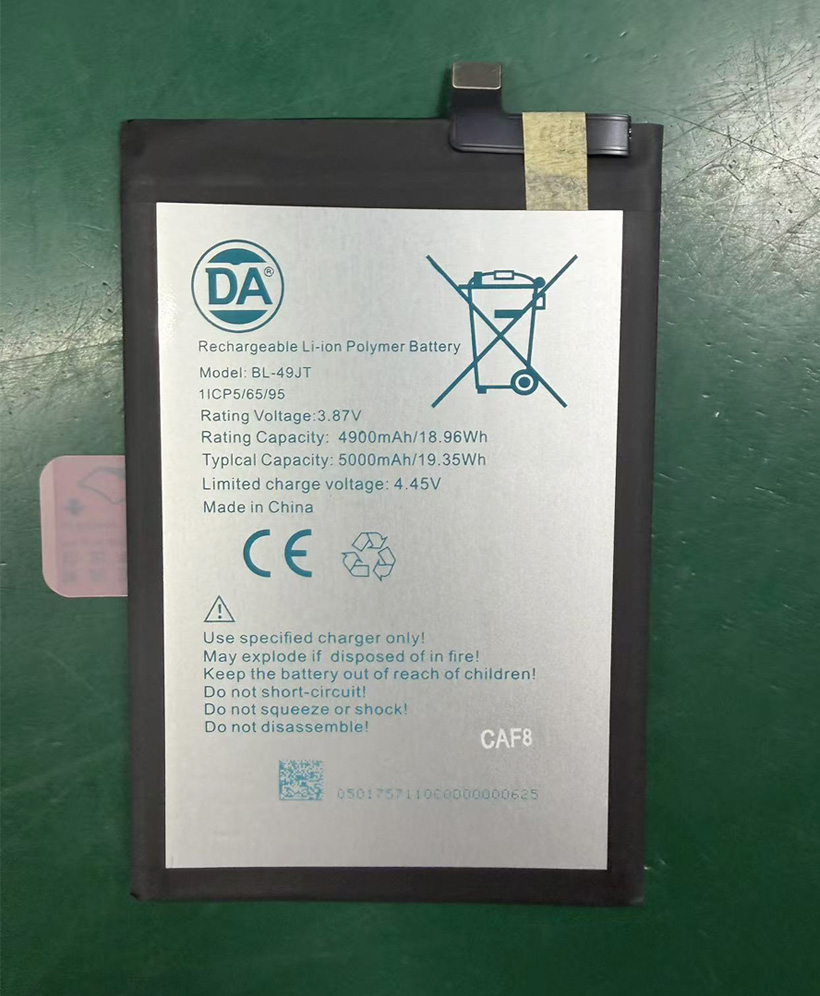
How to Specify a Custom Polymer Lithium-ion Cell (Size, Voltage, C-Rate)
Buying a custom polymer lithium-ion (LiPo) cell is not the same as picking a catalogue SKU. For OEM and ODM programs—tablets, handhelds, POS terminals, wearables, IoT modules—the cell has to fit a fixed enclosure, hit a target run time, and survive the duty cycle your product actually sees. If the specification is vague, sampling stalls, tooling is wasted, and the second lot does not match the first.
This guide walks through the fields a Shenzhen battery factory typically needs before it can quote and sample a custom polymer cell. Use it as a checklist when you email a supplier.
1. Mechanical size comes first
Polymer cells are soft-pouch packages. The three numbers buyers exchange most often are thickness × width × length (T × W × L), usually in millimetres—for example 5.0 × 34 × 50 for a 503450-class cell.
Write down:
- Maximum pocket size inside the enclosure (including tolerance)
- Preferred tab side and tab width
- Whether the cell may swell slightly after formation and cycling (leave soft-pack clearance)
- Any keep-out zones for screws, antennas or heat sources
Do not send only “about 2000 mAh.” Capacity without size forces the factory to guess chemistry thickness and energy density. Size-first specs produce fewer dead-end samples.
2. Nominal voltage and series/parallel intent
Most single polymer cells for consumer and industrial handhelds are 3.7 V nominal (4.2 V full charge). If your board expects 7.4 V or 11.1 V, you are describing a pack (2S / 3S), not a single cell—even if the mechanical envelope looks like one brick.
Clarify early:
- Single cell vs. series string vs. parallel group
- Charge voltage limit your charger IC supports
- Cut-off voltage the product must stop at
Mixing “7.4 V pack” language with “custom cell” language is one of the most common RFQ mistakes. If you need a finished pack with BMS and harness, say so; CXD builds both polymer cells and high-capacity packs.
3. Capacity vs. energy: what you actually need
Capacity (mAh) is easy to put on a drawing. What the product cares about is often energy (Wh) and usable run time under load.
When you specify capacity:
- State the minimum capacity at a defined discharge rate (for example 0.2C)
- Note ambient temperature assumptions if the product runs hot or cold
- Prefer a capacity window (“≥ 1800 mAh at 0.2C”) over a single marketing number
Higher capacity in the same envelope means thicker active material or a denser recipe. That can raise impedance and lower C-rate. If your product pulses hard, push C-rate and voltage sag limits before chasing the last 5% of mAh.
4. C-rate: continuous and pulse
C-rate tells the factory how hard the cell will be worked.
Define:
- Continuous discharge current (or continuous C)
- Peak / pulse current and pulse width
- Charge rate the dock or USB path will use
A cell that is fine at 0.5C continuous may heat or sag when the radio bursts at 2C. Share a rough load profile if you have one—even a simple “idle 50 mA, talk 800 mA for 2 s every minute” helps more than “high rate.”
5. Cycle life and calendar life
Ask for cycle life at a defined depth of discharge and charge protocol (for example 500 cycles to 80% capacity at 0.5C/0.5C, 25°C). For products that sit on a shelf or in a warehouse, mention storage temperature and expected years in the field.
Be honest about duty cycle. Over-specifying “2000 cycles” on a thin high-energy pouch raises cost without changing how the end user treats the device.
6. Protection, wiring and the line between cell and pack
A bare polymer cell is not a plug-and-play battery. Most finished devices need:
- Protection (over-charge, over-discharge, over-current)—on a PCM/BMS or host board
- Connector and wire gauge
- Labeling and packing for assembly
If you only need a matched pouch cell for your own PCM line, say “cell only.” If you need a ready-to-integrate module, request a pack with protection and harness under OEM / ODM customization.
7. Compliance: ask for the documents you will actually ship with
Export programs often need transport and safety paperwork. Typical buyer questions include UN38.3 test summaries, MSDS, and destination-market safety expectations. Only request certificates that your program requires, and only claim certificates your factory has issued for that design. Do not copy a competitor’s certificate list into an RFQ as if it were already yours.
When you write the RFQ, list:
- Destination markets
- Transport mode (air / sea / ground)
- Any customer or retailer audit checklist you must pass
That lets the factory tell you what testing is already available for similar cells and what would be project-specific.
8. Sampling plan and what “same as sample” means
A useful sampling email includes:
- Drawing or competitor sample photo with dimensions
- Target T × W × L and capacity window
- Voltage / series intent
- Continuous and pulse current
- Annual volume estimate (even a range)
- Target sample date and mass-production window
Agree in writing that pilot and volume lots use the same cell recipe, tab layout and formation process. That is what keeps the second shipment aligned with the approved sample.
Quick RFQ template (copy and fill)
Product / application:
Enclosure pocket (T×W×L, mm) + tolerance:
Tab position / width:
Nominal / charge / cut-off voltage:
Series-parallel intent (1S / 2S / …):
Min capacity @ ___ C:
Continuous / pulse discharge:
Charge rate:
PCM/BMS: cell only / pack required:
Annual volume (estimate):
Destination markets / transport notes:
Sample needed by:
Next step
If you already have a drawing or a competitor cell, send it with the fields above. CXD Battery (Shenzhen Changxingda) samples custom polymer cells and carries the same recipe into volume on automated and semi-automated lines.
- Browse polymer lithium-ion cells
- Or request a battery quote via sales@cxdbattery.com